


Invideo Agent One | A Practical Review
We Used InVideo Agent One On A Real Commercial Project. Here’s What We Learned.
Every production has to balance creative ambition with commercial reality. As much as we hate to admit it!
On our latest campaign for Sprinklr, the agency had conceived a simple, but impactful concept. A group of marketers stare at an old phone, waiting for it to ring. So intense is their concentration, they fail to see a fantastical event occurring outside, we’re talking UFOs, explosions, a flying cow. The idea was a great one, but as is often the case, the budget did not align.
Rather than compromising the concept, we took a different approach. Because Sprinklr is itself an AI company, it felt entirely appropriate to embrace AI generated video as part of the production process. The result was a hybrid workflow, combining live action with AI-generated VFX to preserve the original creative vision while keeping the project commercially viable.
It also gave us the perfect opportunity to put Invideo Agent One through its paces on a genuine commercial production. In this article, we run you through our experience of Agent One; the good, the bad and the f****** cow…
Assembling Your AI Crew
To begin with, forget what you know about using other AI aggregators for production. The reason we wanted to use invideo, and specifically Agent One is because it promised a whole new workflow.
Ultimately, the strength of Agent One is in creative collaboration. It’s not just a prompt box, instead, it provides a digital studio in which to focus on your project. More importantly however, it encourages you to build an actual team of specialist AI agents, each with their own production role and expertise. For this project, we created an Art Director to develop the visual design of the UFO, a Location Manager to establish the surrounding cityscape, and a VFX Supervisor who became the backbone of the entire workflow.
With your crew assembled, you have the ability to converse with them, like an LLM and direct them on what you want. Most importantly, however, all your crew members can work on their tasks simultaneously. There’s no risk of a bottle-necked workflow.
Sure, at first, assigning job titles to AI agents feels like a gimmick. In practice, it has a noticeable impact on the conversation. Once created, you’re briefing it exactly as you would a member of your production team, complete with objectives, creative constraints and technical considerations. The result is a much more focused dialogue, where each agent approaches the brief through the lens of their discipline rather than trying to be an expert in everything.
More importantly, it shifts the creative responsibility back where it belongs. Agent One can generate ideas, challenge decisions and solve technical problems, but it still relies on human judgement and guidance to define the vision. The quality of the final work isn’t determined by who writes the cleverest prompt, it’s determined by the person leading the project. In our experience, that’s a much healthier creative dynamic.

IDENTIFYING THE CHALLENGES OF AI
On paper, the brief was straightforward. Looking out from a modern office, a UFO hovers silently above the city. Over the course of thirty seconds, the atmosphere shifts from an ordinary day to something fantastical & extraordinary.
Traditionally, this would be a fairly conventional VFX shot. We’d shoot a locked-off plate, build the city environment, animate the UFO, add digital crowds and vehicles where needed, then layer each element together in post. Every component could be adjusted independently until the shot was exactly right.
In this instance however, we were asking Agent One to behave like a VFX pipeline. That meant balancing a surprisingly long list of technical and creative constraints. Before we began, we knew we had a laundry list of challenges to overcome, some of which, we knew AI was not suitable for…
-
-
-
- A single, locked-off shot – The background had to remain perfectly static for the full thirty seconds so our live-action footage could be composited cleanly on top.
- Thirty seconds of uninterrupted action – Currently, all AI engines have a generation limit of 15-20 seconds, but we needed more…
- Fifteen distinct story beats – The UFO’s arrival, people’s reactions, fighters jets, beamed objects and crowd behaviour all needed to unfold as a consistent narrative.
- Absolute continuity – Buildings, balconies, vehicles and the UFO all had to remain consistent throughout the sequence.
- No separate layers – Unlike traditional VFX, where every element can be adjusted independently, AI generates the entire scene at once. Fixing one problem often creates another somewhere else.
- Timing control – We can’t instruct AI to follow detailed timings, we had to lay out our narrative and trust the AI to pace it.
- Resisting unnecessary creativity – AI naturally wants to make shots more dynamic with camera movement and dramatic flourishes. For a locked off shot, this was unhelpful.
- Maintaining focus – The UFO needed to be spectacular enough to sell the concept, but subtle enough that it didn’t distract from the actors and dialogue inside the office.
- Working with uncertainty – In a traditional VFX workflow, you know what’s possible because every asset is under your control. With AI, you’re constantly discovering whether a limitation lies with the technology or simply with the way you’ve approached the problem.
-
- Taken together, these constraints turned what looked like a simple background plate into one of the most technically demanding parts of the project, and the perfect test of whether Agent One could genuinely contribute to a professional production workflow.
-

When Agent One Changed Its Mind
The biggest surprise wasn’t that Agent One solved a difficult technical problem. It was how it solved it.
One of our biggest challenges was creating a single 30 second take. As noted above, AI generators generally limit video to 15 seconds. We knew we had to stitch together multiple AI-generated clips, but over that amount of action…? This would be a test of the system. Initially, Agent One suggested multiple 5-second clips stitched together. It reasoned that longer clips tend to breathe, shift and add unnecessary camera drift which would be unacceptable for our locked-off shot.
Unfortunately, that proved to be a headache right away.
Movement and inertia changed across the cut making the edit perceptible despite the frames matching perfectly. Rather than defending its approach or endlessly regenerating alternatives, Agent One did something unexpected. It reassessed its own conclusion.
Its first solution focused on matching the position of objects across the edit. What it hadn’t accounted for was their motion. The UFO, vehicles and crowds all resumed with slightly different momentum, creating a discontinuity that our eyes immediately picked up.
Agent One: “You’re right. Pinning the frame matches the position at the cut, but not the speed… The frame lines up; the motion doesn’t.”
It explained exactly why it had failed, and suggested an alternative option that it had, itself, ruled out previously.
Agent One: “Pinning the frame matches the position at the cut, but not the speed. The next clip is generated on its own, so it picks the motion back up at a slightly different pace — the descent suddenly moves differently. The frame lines up; the motion doesn’t. So instead of six short clips and five cuts, I’d build the thirty from two long continuous clips. That leaves a single join at the 15s mark, and I’d land it on the saucer’s hover, where nothing moves fast enough to give the cut away.”
That single response changed my perception of the platform.
Most AI tools simply iterate until something looks better. Agent One demonstrated something closer to reasoning. It formed a hypothesis, tested it against the evidence, accepted that the evidence contradicted its assumptions, then developed a better explanation for what was actually happening.
Its next proposal reflected that new understanding. Instead of trying to perfect multiple stitched clips, it abandoned the idea altogether. The new workflow generated two continuous fifteen-second sequences, placing the only edit point while the UFO was hovering almost motionless. Rather than forcing AI to hide an impossible transition, it redesigned the shot around the technology’s strengths.
This approach worked. Ultimately, the breakthrough wasn’t really about seamless stitching. It was about collaboration. Throughout that exchange, Agent One behaved much less like a prompt-based image generator and much more like a VFX supervisor working through a difficult technical problem. It challenged assumptions, adapted its thinking when presented with new evidence and proposed an entirely different production methodology when the original one proved flawed.
Directing, Not Prompting
With the technical workflow solved, the challenge now became directing the performance.
The UFO needed to arrive at the right moment, people had to react naturally, we had specific demands for the beamed objects, and the whole sequence needed to unfold over thirty seconds without pulling attention away from the actors. It was an ambitious ask for any AI model.
Using Seedance 2.0 through Agent One, the quality was consistently impressive, but it wasn’t perfect. Strange artefacts, odd human behaviour and the occasional visual glitch were all part of the process. In total, we generated close to 300 versions before finding a pair of clips that worked together.
What stopped that becoming frustrating was the conversational workflow. Every iteration built on the last, allowing us to make simple creative adjustments. We weren’t constantly rewriting prompts, we were directing the nuances of the scene, and each time, the action got better and better.
I don’t think this would have been practical with a traditional AI aggregator, and certainly not with a standalone text-to-video model. Agent One’s ability to retain context turned hundreds of generations into a continuous creative conversation, rather than hundreds of disconnected attempts.
Never Work with Animals…Still
Now, there was one moment in the project that became a bit of a running joke…
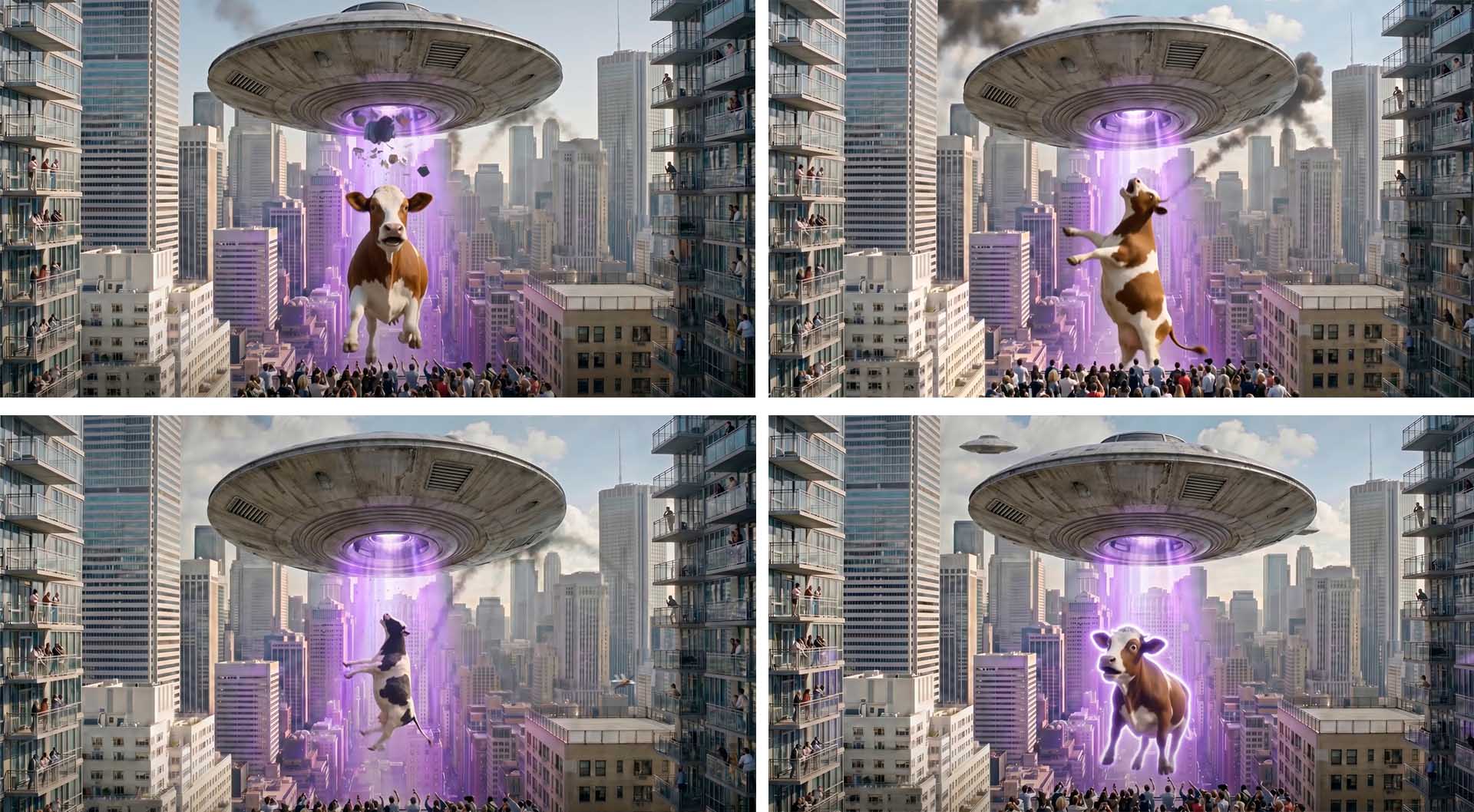
Our script demanded that the UFO beams up objects from the street below, one of those objects was to be a cow. Seemed simple.
For reasons we never quite got to the bottom of, the Seedance engine absolutely refused to generate one at the correct scale. Every attempt produced a cow that was inexplicably enormous. What was interesting wasn’t that the model struggled with comparative scale (that’s a known limitation of generative AI) it was once again how Agent One responded. Rather than endlessly tweaking prompts in the hope that one would magically fix the problem, it gradually concluded that we’d reached the limits of what the underlying model could reliably do.
Instead of pretending otherwise, it simply said, in effect, “I think we’ve hit a wall.” That honesty was surprisingly refreshing.
Rather than burning through another fifty generations chasing a marginal improvement, Agent One instead suggested the sort of pragmatic solution a real VFX supervisor might recommend, accept the best version, then adjust the scale through compositing. Sure, it wasn’t the answer we wanted but it was the right one.
So, What’s the Verdict?
After several weeks of working with Agent One on a live commercial project, one thing became very clear. Its biggest strength isn’t generating AI video, it’s making AI video feel collaborative.
Throughout the project, it demonstrated a genuine understanding of filmmaking. It understood continuity, pacing, compositing, camera movement and the practical realities of building shots that needed to survive a professional post-production workflow. More importantly, it retained that understanding throughout the project, allowing conversations to evolve naturally rather than forcing us to start from scratch with every iteration.
That doesn’t mean it was perfect. Like every AI video platform we’ve used, it still inherits the limitations of the underlying models. Visual artefacts appear, continuity occasionally drifts, and some requests simply remain beyond what’s currently possible. The difference is that Agent One usually recognised those limitations too. Rather than blindly generating another version, it often analysed the problem, proposed a different workflow or simply admitted we’d reached the limits of the technology.
Ultimately, what impressed us wasn’t the quality of any single generation. It was the quality of the collaboration. Agent One consistently felt like another member of the production team, one that could reason through problems, retain context and contribute meaningful ideas throughout the creative process.
For production companies, that’s a far more exciting prospect than another AI video generator.

